Showing posts with label birding travel. Show all posts

Friday, April 7, 2017

Ten Pro Tips for When You're Stuck at the Airport

Friday, April 7, 2017
42 comments
Today I'm trying to fly to Portland, Maine from Columbus, Ohio. But the travel demons are afoot and the only flight delayed from the John Glenn International Airport in Ohio's capital city is the one I'm on to Detroit. This means I will probably miss my connection in Detroit to Portland, Maine. ¡Así es la vida!

This kind of thing happens and it's happened to me before. So here are some tips, coping strategies, and suggested activities for you, the stranded birding traveler, the next time you find yourself in an airport with a loooooong delay.

Pro Tips for Dealing with Flight Changes & Challenges

1. Calm Blue Ocean. Don't let this unexpected wrinkle rattle you. Say your mantra. Count to 10. Do some yoga breathing. But don't lose your cool because that helps exactly zero percent.

2. Take Action Immediately. Often the first folks trying to re-book are the lucky ones who get a satisfactory result. Find an actual person at the airline's help/service desk. Then...

3. Be Super Nice & Cheerful. The folks at the counter or gate hold you destiny in their hard-working hands. Upset travelers are almost never nice to these professionals, so if you are, they are more likely to empathize with you and help you to solve your travel dilemma.

4. Ask for Advice. I've had several trips saved from oblivion by throwing myself on the mercy of an airline gate or ticket agent. This is helped mightily if you can abide by #3 above. They can use their computer wizardry to find alternate flights, routes, and solutions to your travel dilemma.

5. Stay Informed. I keep abreast of flight delays, gate changes, and other curveballs via my airline's app and other helpful apps, such as FlightStats. I'm often the first to receive updates—sometimes even before the gate agents.


6. Long, Unexpected Layover? Buy a magazine or newspaper (I treat myself to the New York Times when traveling). Buy some WiFi and download a movie or TV show. Get an airport massage.

7. Rest & Recharge. Find an unused gate with a quiet corner seat and an electrical outlet or charging station. You can recharge your electronics and yourself. I recently did this in Schiphol Airport in Amsterdam and the nap completely saved my day.

8.  Use Yelp for Food. I use the app Yelp to find the best non-chain airport restaurants. So what if you need to go to another terminal to get the best shrimp-n-grits? That beats eating a hotdog that's been in the weiner broth since the Wright Brothers took flight at Kitty Hawk.

9. Avoid the Bar. I know a beer or bloody Mary would taste super right now, but airport bars are great places to have one too many, lose track of time, and miss the announcement that your flight is boarding. "William Thompson, William Thompson! Please report immediately to Gate Z-74. Your flight to Oskaloosa is ready for immediate departure!"

10. Bird the Airport! If you're  birder like me, you're never not birding. Believe it or not there are birds inside most airports the world over. And there is often good birding outside the airport windows. Walk around, find the best habits and start watching. NOTE: Some international airport security officials may not understand that you are just birding. You may want to tell them in advance just what you are doing. Showing them your field guide helps.

11. Accept Your Fate. If the travel gods are frowning upon you, don't rage against the machine. If you're truly stuck, you're stuck. Inform your peeps what's happening, find a hotel room, and live to fly again tomorrow. And get that bloody Mary.

Friday, August 12, 2016

American Birding Expo 2016!

Friday, August 12, 2016
2 comments
We're calling it "The World of Birding in One Place!" 


It's the American BirdingExpo and once again Columbus, Ohio, will be buzzing with birders and birding businesses for three busy fall days, September 16 to 18, 2016. Last year more than 2,500 people and 85 exhibitors, hailing from 35 U.S. states and 31 countries joined us for the first-ever Expo at the Grange Insurance AudubonCenter and Scioto Audubon Metro Park. It was monumental fun, and now we're gearing up to do it all again!

Here's this year's limited-edition Expo poster! Designed and hand printed by Bobby Rosenstock/Just A Jar.

In year two of the Expo, there will be more than 100 exhibitors from all over the world selling and promoting everything a birder could want: birding tours, optics, cameras, gear, clothing, bird feeders and houses, artwork, gift items, books, plus destinations, festivals, birding and conservation organizations, and more.
Stephen Ingraham from Carl Zeiss Sports Optics converses with two Expo attendees.

There will be a full array of optics available at the Expo. 
Have I piqued your curiosity, yet? If so, you might have some questions...

How is the Expo Different from a Regular Birding Festival?
As the Expo name suggests, this is an exposition of birding products, destinations, and services. While many of the continent's best birding festivals have a vendor area as a part of the festival, the Expo is nothing BUT a vendor area, with exhibitors on full display mode for most of three days. It's like a grouse or prairie chicken lek where the exhibitors are the displaying male prairie chickens and the consumers are the gathered females, just waiting to be impressed. 

Of course, there are a few similarities between a birding festival and the Expo. We will offer informal morning bird walks before the Expo opens each morning, and many of our exhibitors will be giving short presentations during the Expo. However the central purpose of this event is to connect the worldwide birding marketplace to North American bird watchers. So that's just what we'll do from noon to 6 p.m. on Friday, from 9 a.m. to 5 p.m. on Saturday, and from 11 a.m. to 4 p.m. on Sunday.

By the way, the Expo is hosted by Bird Watcher's Digest and co-hosted by our friends from the American Birding AssociationGrange Insurance Audubon Center, and Franklin Country MetroParks.

Do Some Good: Expo Conservation Fund
Not only is this a nature lover's very best chance to sample everything the birding marketplace has to offer, it's also a chance to contribute to bird conservation and nature education through the Expo Conservation Fund. We're once again supporting three vitally important causes: one local, one national, and one international with the funds we raise during the Expo. 

Here are the causes that the Expo Conservation Fund supports:
Local Cause: The Young Urban Naturalists Program at Grange Insurance Audubon Center—sharing the wonders of nature with young people from Columbus City Schools. 
Partner: Grange Insurance Audubon Center.


The Young Urban Naturalists Program


National Cause: Red Knot Rescue and Conservation—funding field study and habitat acquisition efforts along the Delaware Bayshore.
Partner: The American Birding Association

The rufa race of the red knot is critically endangered.


International Cause: Save the Hooded Grebe of Argentina—funding the urgent and vital efforts of BirdLife International and Aves Argentinas to rescue this species from the brink of extinction.
Partner: BirdLife International. The American Birding Expo is proud to be a BirdLife Species Champion for the Hooded Grebe.
Adult hooded grebe with chicks on its back.


How Will the Expo Raise the Money? 
I'm glad you asked!

Although entry to the Expo is free, we're asking for a voluntary $5 per person contribution at the door, which will go directly to the Expo Conservation Fund. We'll also be selling tickets 
to the Expo Conservation Raffle with prizes that include discounted overseas trips, more than a dozen binoculars and scopes, giant gift baskets for birders, original art, and a mind-boggling array of other items. 

Deeper Meaning
All of this stuff is really great, but the Expo means so much more to me than just numbers and products. It's like a family reunion with all of my favorite people from all over the world. I've been so fortunate to get to travel the globe, seeing the birds and meeting the birders of some pretty far-off and fantastic places. So it's wonderful beyond description to be the host of an event that gathers the birding tribe from far and near to meet and connect with one another, and to come together to do some good for birds and the future of birding.

Here's a video we recently completed that gives more insight into the Expo.


So, what do you say? Want to experience The World of Birding in One Place? There's only one spot in this hemisphere where you can do that: The American Birding Expo in Columbus, Ohio, September 16–18, 2016.

If you're planning to come to the Expo, consider registering in advance because it has some advantages. Pre-registrants get a subscription to the Expo e-newsletter  plus notifications about specials, invitations to exclusive Expo events, and expedited entry when they arrive. There's no cost to preregister.

I'll see you out there with the birders!
—BOTB


Thursday, May 26, 2011

Appalachia to Asia

Thursday, May 26, 2011
2 comments
I'm sitting in my home office today in the Appalachian foothills of southeastern Ohio (and will continue doing this over the coming holiday weekend) trying to write a compelling, readable account of an adventure I had back in March of 2009 in The Philippines.

The subject of the article I'm writing is a trek I took with some birding pals (pictured above) to see the Philippine eagle on a mountain in Mindanao.

This photo (above) of the thick mountain jungle with a bit of rising mist (or is it smoke?) figures prominently in the story, which will appear in the September/October 2011 issue of Bird Watcher's Digest. If you don't subscribe to BWD, dang it, ya should, because you're missing out on some of the best bird-related content on the planet. You can get an entire year of both the printed-on-paper version of BWD and eBWD our enhanced digital edition for less than $20.

Just wanted to post this today to note how weird it was to be sitting in these old mountain foothills in Ohio, remembering our incredible hike up Mt. Kitanglad on Mindanao. It's all coming back to me now...

Monday, November 29, 2010

Encountering the Warrior

Monday, November 29, 2010
9 comments
Warrior, of the Huli people in Papua New Guinea.

On an afternoon trip from Ambua Lodge to a nearby roost site of a sooty owl, our birding group got its first encounter with a member of the local Huli people. The roost site was in a cavity in a tall eucalyptus-like tree in the middle of some hand-planted crop fields.

I wish I had photos of our initial moments with the man I came to know simply as Warrior. He was a Huli wigman who appeared in the middle of the road as we were trying to execute a too-tight turn in our combi-bus. He initially waved and smiled, and beckoned us to drive after him down the road. He was running barefoot down the road in front of us, feathered headdress waving with his movement, a bundle of leaves covering his backside.

That's Warrior on the right, walking in front of our bus.

As our bus started to follow him, he suddenly whirled, notched and arrow and aimed it at us through the windshield. I must admit that I jumped and dodged behind the seat back in front of me. A palpable surge of momentary fear had gone through our group. And just as quickly, the man smiled and laughed, turning to resume his trot down the road.

Fewer than 100 yards later, a washed out bridge prevented our further progress, so we dismounted and continued on foot. The wigman immediately came up to me to show me his bow and arrows. I was fascinated, and he could tell. Our conversation went like this:

"I sell you all 75 kina!" he said.
"No thanks. Please tell me your name!"
"Warrior!"
"Is that really your name?"
"Yes, I warrior. What name bilong you?"
"My name is Bill."
"Beel! My fren!"

Warrior tried once or twice more to sell me his arrows, but each time I politely declined and asked him another question. Despite our language difficulty—he did not speak much English and I could only discern certain phrases in Pidgen, the language most common in Papua New Guinea, a mash-up of English, German, and various local tongues—we learned a lot about each other. The land where we were going to find the sooty owl was owned by him and his clan. He did some farming, but mostly hunting and guiding people. I asked him is this was how he dressed every day, and he confirmed it. Looking closely at his headdress, I could see cassowary feathers, two sulphur-crested cockatoo feathers, fresh plant stems and leaves, and a carefully folded and pinned-in-place label from a food product. A long tan reed was centered beneath the tip of his nose, inserted through a hole in his septum. Elaborate patterns were painted on his face in red, yellow, and black.


We'd be instructed to ask for permission to take photographs of the people we would encounter—this is only common courtesy after all. But we'd also been asked/advised not to pay money for this privilege, since PNG is trying to maintain a spirit of friendly hospitality for visiting tourists. The concern being that if every photo-taking tourist is made to pay to take photographs, the local culture and customs could devolve into mercenary commerce, opening the door to more of the problems caused by so-called "rascals" who commit crimes against tourists and travelers.

It can be a rare thing to enjoy an authentic encounter with someone native to a country you are visiting. Sometimes a place and its people are so inured to tourists that they have little interest in answering the same handful of questions from yet another busload of visitors ("Do you really live here? What do you eat? Did you make that yourself?"). Or, and this is becoming much less common in our modern world, you visit a place where few outsiders go and the people are very shy and reticent. Either way, it can be difficult to get an authentic feel for the people and place.
Waiting for the owl.

I suspect that Warrior could easily rev-up his guiding "act" for a bunch of oblivious tourists. He shot several bamboo "arrows" for us—at a cloud, at a distant tree. He did not shoot any of the more finely made arrows he held in his hand. As we walked along, talking, he seemed to enjoy getting to know me as much as I did him.

We crossed through a farmyard and over a series of creeks, then through planted fields, trying our best to avoid stepping on the vines of the plants growing from the ground. Once at the roost site, one of the local men went forward and used a 30-foot long pole to scratch the side of the tree. This was meant to get the owl to peek outside, which it did. But the owl was startled enough from his daytime slumber that it flew off to a nearby copse of trees.

The roost tree, with the cavity (on the upper left fork)

I had been videotaping the tree scratching, but when the owl peeked out I went for my binoculars and completely missed getting any shots or footage.
After-owl group photo with the local family and our guides.

Our group posed for some photos with the local family and our guides at the owl roost.

The farmer, including Warrior, are paid a fee each time a group of bird watchers visits. This is an excellent example of grassroots ecotourism. The local villagers know that by protecting the owl and its roost tree, they can earn money from visiting groups. We discussed ways to show the owl without spooking it from its roost, and the local folks assured us that the owl usually peeks out for a minute or so and then goes back down inside the cavity to sleep.
Walking through the cultivated fields.

On our way back to the road it began to rain quite heavily. Within minutes we were all soaked through and getting chilled. At the road, we parted company with Warrior and his family. I did buy an arrow from him and he told me about how he made it. He made a slit along one side of the arrow shaft. Into this shaft he inserted some small seeds. He told me that when this arrow goes into his enemy, those seeds will make it hurt more. Knowing how intense the fighting can be among rival clans in PNG, I did not doubt Warrior's sincerity or intent.

The arrow's construction was ingenious. It was designed to come apart mid-shaft. And it was beautifully carved and decorated with paint. The balance was perfect and though I will never shoot it from a bow, I am sure it would fly straight and true.

Before we left Warrior and his family I asked if I could take his photograph.

"Yes, Beel, you my friend! Take photo!"
Warrior posed for me to take his photo.

I did and we shook hands and turned to go our separate ways returning to our separate and very different worlds. I'm not sure Warrior will remember me, but each time I look at the red arrow, I surely remember him.

That's me with my arrow, wearing one of the traditional hats worn in PNG. This one is woven in the colors of the national flag.

Wednesday, October 20, 2010

Journey to the Other Side of the Earth

Wednesday, October 20, 2010
3 comments
I've been away for a while.

Not just away, but far away, as in the other side of the planet. I was on a birding trip to Papua New Guinea and, my friends, it was the trip of a lifetime.

Over the next few weeks and months, I'll be sharing some of my experiences in PNG with you here at Bill of the Birds. Eventually I hope to create both a magazine article for Bird Watcher's Digest and a podcast episode for "This Birding Life."

For now I'll start things off with one of my favorite images (above) from the trip. It's me wearing all my birding gear, including my leech socks, standing next to a Huli wigman in the southern highlands near Tari. He told me, as we walked across his land, that his name was simply "Warrior." Warrior helped to guide us to the roost tree of a sooty owl—just one of the nearly 300 species we saw during the three week trip.

It's always a magical thing to be some place that's completely different from what I'm accustomed to—different people, landscape, language, customs, food, and, yes, different birds. PNG qualifies with flying colors on all counts.

More to come about Warrior, and all the people, places, and birds of Papua New Guinea.

Wednesday, June 2, 2010

This Birding Life, Episode #26

Wednesday, June 2, 2010
0 comments
A male Guyanan cock-of-the-rock, one of the most exciting species in Guyana.

Episode #26 of my podcast "This Birding Life" was just pulled out of the Easy-Bake Oven and is now available for downloading. This episode is entitled "Voices of Guyana." It's available (free of charge) in the usual places—at Podcast Central on the BWD website and in the iTunes Store in the Podcast section (just search for "This Birding Life").


Like most of the 25 episodes that preceded it, this one is available in two formats: audio only (mp3) and enhanced audio with still photos (m4a).


As you might surmise from the title, "Voices of Guyana," this episode is a series of interviews I conducted on my trip in March of 2010 to Guyana. I was there as a part of a familiarization tour for journalists and tour operators to sample bird watching in Guyana. The trip was amazing, the birds were as fabulous as they were numerous, and the people of Guyana were a complete pleasure to meet (with the possible exception of Mr. Dogg the somewhat cranky pick-up truck driver, but that's another story for another time...).

Asaph Wilson was our primary guide for the Guyana birding trip.

I've been writing some here on BOTB about my experience in Guyana. There's more coming, too, both here and in the pages of Bird Watcher's Digest, and on the BWD website, where we have created a special Guyana section.
Six of the participants in the Guyana fam tour in March 2010 and a termite mound (behind).

Guyana is a country that is only just emerging as a destination for ecotourists. If you'd like to know more about this amazingly birdy South American country, please take a stroll through some of the content we're offering in these various formats.

Thanks for reading, watching, listening.

Tuesday, April 27, 2010

Part 3 Birding Guyana: Flying to the Interior

Tuesday, April 27, 2010
5 comments
Buff-necked ibis.

I like to start off my BOTB blog posts with a bird photograph if at all possible. So I am inserting this image of a buff-necked ibis here, even though it is out of order in the time line of this post. I believe the buff-necked ibis might be the second most beautiful ibis in the New World, right behind the scarlet ibis. Good thing there is not a Scarlett Johannson ibis, or that might take the crown. Now, where were we...

Oh yes! Guyana.

After a lovely (too short) morning of birding in the botanical gardens in Georgetown, we were herded to the small, in-town airport for a flight to the interior of Guyana. Because we were taking a small 12-seat plane on this flight, weight was an important factor. We had been warned about this in advance by our hosts and leaders, but that didn't stop us—well it didn't stop me—from bringing far too much stuff. We were weighed by our trip leaders at the hotel. Then weighed again at the airport. I won the avoirdupois prize as the heaviest traveler. Fully one-third of my things—mostly stuff I would not need immediately—was sent by bus overland, along with extras from my fellow travelers.

We were all caught between the pull of wanting to have all of our camera and birding gear with us, along with the proper clothing and footwear, and the necessity of packing the absolute minimum. We also had to send one of our leaders on the land bus. That alone saved us more than 300 pounds of humanity (sorry, just kidding Michael).

Negotiating the payload for our flight. Michael (black backpack, no hair) drew the short straw and had to ride the overnight chicken bus to Iwokrama.

Onto the plane we went and in moments we were in the air flying away from Georgetown. Below us stretched miles of housing, then the houses were replaced by a ring of cane fields.
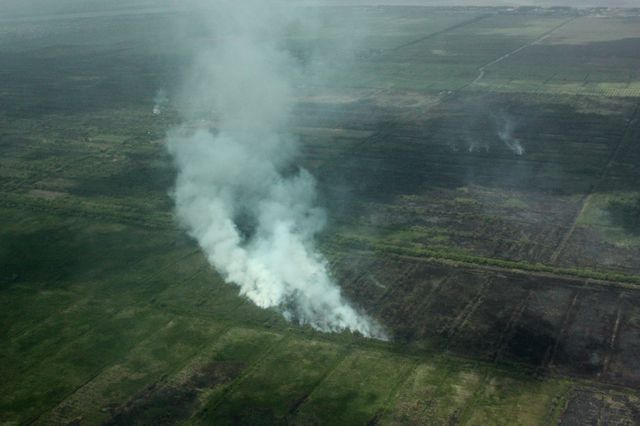
Some of the cane fields were being burned off and we could see and smell the smoke rising from the earth.
Then we were away from all signs of human habitation and civilization. Below us lay unbroken rain forest, a vast carpet of green. It was a sight that did the heart some good. This is why we were here—to experience what is perhaps the last vast expanse of undisturbed rain forest in South America.
The Guyana rain forest from the air.

Our destination, the Annai landing strip, hove into sight. While flying we'd seen a few birds—turkey and black vultures mostly, with two distant king vultures for added spice. I strained my eyes hoping to catch sight of a harpy eagle perched on one of the emergent snags jutting above the forest canopy, but was unsuccessful.
The Annai landing strip is a dirt road next to Rock View Lodge, one of the largest eco-lodges in Guyana. Stepping from the plane we felt our knees buckle in the mid-day heat. Soon cold drinks and a nice lunch at Rock View Lodge helped revive us.

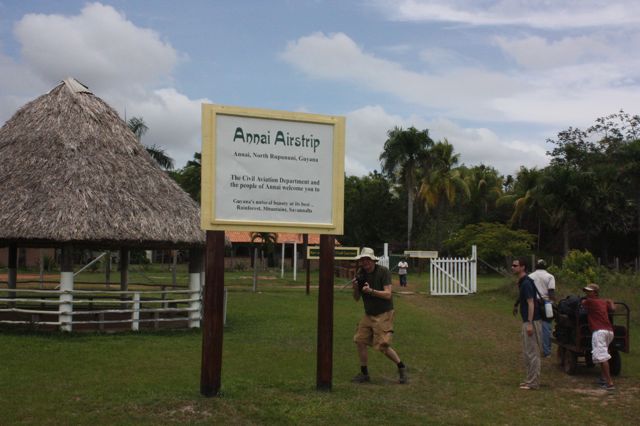
Dr. Steve Banner struggles to find just the right angle for a photo of the welcome sign while leader Kirk Smock looks on in wonder.

The plane! The plane! The plane we came in on.

After lunch we began birding the grounds. Palm and blue-gray tanagers were common. A white-necked thrush was building a nest under the thatched canopy of a benab. I caught a fleeting glimpse of a burnish-buff tanager in a fruiting tree. A horse corral held a number of southern lapwings and the aforementioned buff-necked ibis. I had the feeling that this place would be much birdier early in the morning.

Leon gives us the run-down at Rock View Lodge.

Leon, a guide at Rock View Lodge, gave us a tour of the grounds and facilities, which included very nice guest rooms, a bar and general store, a huge vegetable garden, and the stony promontory from which the lodge derives its name. I would have been content to stay right on that overlook for the rest of the day, conducting a Big Sit, perhaps with a run to the store for some munchies and a frosty cold beer, but our leaders needed to get us on the move. This would become a theme of the trip.

We boarded several 4x4 trucks and headed down a long, straight, red-clay road. Destination Iwokrama, a field station and eco-lodge owned and operated by the Makushi people in the heart of the vast Iwokrama Forest. If one were to drive directly, I suspect this trip would have taken about two hours. We birders found so much to look at that we stretched the drive until well after dark. Arriving at Iwokrama, we hauled our luggage to our rooms, splashed our faces with water and reconvened at the main building for a late dinner. By the time we finished eating and had a brief orientation meeting, I was so tired my eyes were crossing.

Everyone hurried back to their cabins to get ready for bed before the generator was switched off. This was our first night sleeping without air-conditioning under the very necessary mosquito netting. I tried to recall the life birds I'd seen that day but did not get far before dropping into slumberland.

At each stop we made, new tropical delights were discovered.

In my next post, I'll share some of the special sightings from the road to Iwokrama.

[BACK TO TOP]