Tuesday, November 7, 2017

Ear Candy Alert: Latest Podcast Episodes!

Tuesday, November 7, 2017
326 comments

If you enjoy listening to podcasts about birding, there are new episodes posted in the past few days from two podcasts in which I'm involved.


This Birding Life has been going for more than a decade and just passed the 70 episode count. Episode 73 is a collection of four different birding-related stories I recorded during a recent trip to Taiwan. These first-person tales range from trying to charm you way into an exit-row seat on an international flight to being rescued in dire remote circumstances. Here's a link to listen to episode 73 of "This Birding Life" entitled "More Birding Stories."


That's me in the yellow sleeves with our Taiwan birding group.


"Out There With the Birds" is the second podcast I'm part of, along with my colleague and friend Ben Lizdas. Where TBL is an interview-style podcast with me interviewing an interesting person or people, OTWTB is pretty much just Ben and me talking back and forth about anything that comes to mind. And we usually crack up along the way.


Ben lives and works outside of Madison, Wisconsin, so most of our episodes are recorded via Skype, which makes the audio quality , occasionally challenging. When our paths converge, we record episodes in person and take lots of silly selfies.  Here's a link to a recent episode that included a short discussion about recent research into male duck genitalia.


If you like what you hear, please click on the RSS feed link to be notified when new issues are posted. TBL is once monthly, OTWTB is twice monthly. In between episodes, you should go birding.

Happy listening! We'll see you out there with the birds!


Friday, October 20, 2017

Giant Things of Oaks, PA

Friday, October 20, 2017
184 comments
I just remembered I still have a blog, such as it is. 
And one of my most favorite-ist blog post categories ever is Giant Things. Go ahead. Search the Bill of the Birds archives and let the wonders fill your eyes. And your nightmares.

This beauty of a Giant Thing is in Oaks, Pennsylvania, standing outside an indoor amusement park and immediately adjacent to the Greater Philadelphia Expo Center, where we just held the third-annual American Birding Expo. My guess is Ol' Jughead used to be holding a wrench or some other sort of tool, advertising a car repair center. Now he's standing, empty handed, on the edge of a parking lot, next to his buddy, Life-size Giraffe.

Lifesize Giraffe and extraneous minutiae.


Ben and I spied the Giant Things and had to hold an impromptu photo session. We like to get selfies for use with our "Out There Wth the Birds" podcast. Check out episode 21 in which we walk the aisles of the 2017 Expo, talking to ourselves and others.
No, Ben is not head butting Jughead in the photo above.

Later in the weekend, the Expo staff from Bird Watcher's Digest, along with two of our super volunteers, Ann Hannon and Jessica Melfi, struck a pose with Juggers.

You can find these Giant Things for yourself, when you come to NEXT YEAR'S EXPO, September 21 to 23, 2018, at the Greater Philadelphia Expo Center.

If you come, we can take a selfie!

Thursday, June 8, 2017

Spring Migration 2017, Part 2

Thursday, June 8, 2017
143 comments
Birders at Magee Marsh.

For those of us who are still scratching our heads about this year's spring bird migration, there seem to be more questions than answers and, of course, theories aplenty. Only yesterday (June 8) there was a female black-throated green warbler in our yard in southeast Ohio—a bird that should be in the northern forests brooding eggs or feeding nestlings by now.

The dedicated news team at our Out There With the Birds podcast sent Ben Lizdas, cub reporter, into the field to speak to two migration experts for a special episode focused on spring migration. Ben spoke with Greg Neise of the American Birding Association and Dr. David LaPuma, director of the  Cape May Bird Observatory.
Greg Neise of the American Birding Association.
Dr. David LaPuma of Cape May Birding Observatory.


Both of these guys are avid birders with loads of spring migration experience—Greg primarily in the upper Midwest in Illinois and David in both Wisconsin and New Jersey. I found what they had to say quite informative and most interesting.

You can hear their take on spring migration 2017 by listening to Episode 13 of Out There With the Birds: Spring Migration Report.

Enjoy and happy (late) spring birding!
Your OTWTB podcast hosts Bill (left) and Ben (cub reporter).

Thursday, May 25, 2017

How Was Your Spring Migration?

Thursday, May 25, 2017
68 comments
Taking a respite from posting all my content, quips, and thoughts to the immediate-gratification machines of the social media channels, I thought I'd add a pithy question here on the dusty old Bill of the Birds blog.

Male cerulean warbler.

So...How was spring migration in your area?

I'm hearing that the spectacle of migration was quite unimpressive in many parts of the eastern half of the United States. I was at Magee Marsh in northwestern Ohio from May 10 to 14—which normally would be at or near the peak of spring songbird migration. My experience was one of "more people than birds," which is unusual for that spot at that season. Even at my farm in southeastern Ohio the migration seemed to be in dribs and drabs with no single day standing out as impressive or amazing.

All of this begs the question: Is this our new subdued migration reality? Have we reached (or passed) some sort of songbird-population tipping point where numbers of warblers, thrushes, tanager, orioles, vireos, etc, have crashed? In other words, are we experiencing "Silent Spring?"

Or, is this spring an anomaly, affected by weather, foliage development, insect hatches, etc?

I'd love to hear how the migration was in your region. Please use the comments section here, or comment on the inevitable Facebook and Twitter posts for this blog topic.

In an upcoming episode of our Out There With the Birds podcast, Ben Lizdas interviews several avid birders about the spring migration of 2017. Tune in to find out what they say.

Male prairie warbler.

Friday, April 7, 2017

Ten Pro Tips for When You're Stuck at the Airport

Friday, April 7, 2017
43 comments
Today I'm trying to fly to Portland, Maine from Columbus, Ohio. But the travel demons are afoot and the only flight delayed from the John Glenn International Airport in Ohio's capital city is the one I'm on to Detroit. This means I will probably miss my connection in Detroit to Portland, Maine. ¡Así es la vida!

This kind of thing happens and it's happened to me before. So here are some tips, coping strategies, and suggested activities for you, the stranded birding traveler, the next time you find yourself in an airport with a loooooong delay.

Pro Tips for Dealing with Flight Changes & Challenges

1. Calm Blue Ocean. Don't let this unexpected wrinkle rattle you. Say your mantra. Count to 10. Do some yoga breathing. But don't lose your cool because that helps exactly zero percent.

2. Take Action Immediately. Often the first folks trying to re-book are the lucky ones who get a satisfactory result. Find an actual person at the airline's help/service desk. Then...

3. Be Super Nice & Cheerful. The folks at the counter or gate hold you destiny in their hard-working hands. Upset travelers are almost never nice to these professionals, so if you are, they are more likely to empathize with you and help you to solve your travel dilemma.

4. Ask for Advice. I've had several trips saved from oblivion by throwing myself on the mercy of an airline gate or ticket agent. This is helped mightily if you can abide by #3 above. They can use their computer wizardry to find alternate flights, routes, and solutions to your travel dilemma.

5. Stay Informed. I keep abreast of flight delays, gate changes, and other curveballs via my airline's app and other helpful apps, such as FlightStats. I'm often the first to receive updates—sometimes even before the gate agents.


6. Long, Unexpected Layover? Buy a magazine or newspaper (I treat myself to the New York Times when traveling). Buy some WiFi and download a movie or TV show. Get an airport massage.

7. Rest & Recharge. Find an unused gate with a quiet corner seat and an electrical outlet or charging station. You can recharge your electronics and yourself. I recently did this in Schiphol Airport in Amsterdam and the nap completely saved my day.

8.  Use Yelp for Food. I use the app Yelp to find the best non-chain airport restaurants. So what if you need to go to another terminal to get the best shrimp-n-grits? That beats eating a hotdog that's been in the weiner broth since the Wright Brothers took flight at Kitty Hawk.

9. Avoid the Bar. I know a beer or bloody Mary would taste super right now, but airport bars are great places to have one too many, lose track of time, and miss the announcement that your flight is boarding. "William Thompson, William Thompson! Please report immediately to Gate Z-74. Your flight to Oskaloosa is ready for immediate departure!"

10. Bird the Airport! If you're  birder like me, you're never not birding. Believe it or not there are birds inside most airports the world over. And there is often good birding outside the airport windows. Walk around, find the best habits and start watching. NOTE: Some international airport security officials may not understand that you are just birding. You may want to tell them in advance just what you are doing. Showing them your field guide helps.

11. Accept Your Fate. If the travel gods are frowning upon you, don't rage against the machine. If you're truly stuck, you're stuck. Inform your peeps what's happening, find a hotel room, and live to fly again tomorrow. And get that bloody Mary.

Friday, March 3, 2017

Birding in Stereo: The New BTX from Swarovski

Friday, March 3, 2017
12 comments
The new BTX from Swarovski offers binocular vision through a spotting scope.
There is a clash of Titans at the top of the sport optics field among three European optics manufacturers—Swarovski, Zeiss, and Leica—vying to be the brand that you choose when purchasing a high-end binocular or spotting scope. Your average serious birder interested in using the best optics available could select a model from any of these three companies and be deliriously happy. In the rarified air of these highest, high-end optics, the differences in the optical quality from one to another is probably beyond what the human eye can perceive. It comes down to what feels good to you personally—in the hand, to your eyes, and around your neck. I own and use optics from all three companies and have enjoyed years of amazing optics performance from them.

When one of these manufacturers develops a new product that they feel is important, or even game-changing, they sometimes organize a tour or event to help launch the new product in a big way. That's how I found myself on an airplane bound for Innsbruck, Austria, just a few hours after returning home to Ohio from the Space Coast Birding Festival in Florida. I'd been invited, along with a bevy of other journalists, optics retailers, opinion leaders, and marketing professionals, to attend the unveiling of a new, top-secret product from Swarovski Optik.

I won't keep you in suspense—like they did us. The new product is called the BTX, and it's a modular binocular unit that fits onto the existing ATX/STX line of Swarovski spotting scopes. This means that if you already own a Swarovski ATX/STX  spotting scope, you can purchase the BTX unit and dynamically change how you use your scope. You simply remove the existing single eyepiece section and replace it with the BTX, rotating it and snapping it in place exactly as you would the eyepiece.

Let me explain in my typically non-techy way what is special about the BTX (which stands for Binocular Telescope. ATX and STX stand for Angled and Straight Telescope, respectively.)

The BTX offers incredible, stereoscopic viewing by combining a binocular vision/two-eyed image with the magnification power of a spotting scope. The image gathered by the objective lens of the scope is split into two images in the front end of the BTX and delivered, in stereo, to your eyes. This is something you probably have to experience to understand fully. And I'm sure you'll get a chance at one of the birding festivals later on in 2017 where Swarovski is certain to have the BTX on display.
The BTX can mount on any of the three ATX/STX objective lens bodies.

Like any binocular, the BTX has multiple adjustments that must be made for optimal, customized, individual use. These are:
  • the inter-pupillary distance (the barrels adjust in or out like binocs to match the distance between your eyes)
  • the eye relief for those who wear glasses (adjusted by rolling eyecups up or down)
  • the diopter (to correct for differences in visual acuity between your two eyes; adjusted on the right eyepiece)
  • and the forehead rest
The what?

Yes, the forehead rest. The BTX comes with a forehead rest that makes the viewing experience more stable and somehow more relaxing.

The optics inside the BTX are a product of meticulous engineering and rigorous testing, as we've come to expect from Swarovski. I don't pretend to understand the physics behind how the BTX functions optically, but I can tell you that watching birds in stereo is magical.

I noticed much greater plumage detail on distant ducks, despite the mostly gray and drizzly conditions in which we were birding. Birds seemed to pop out of their surroundings because the stereo view added dimension and a shallower depth of field, which made the focus seem much sharper.

Standing on the shore of Lake Constance, in Austria, scanning through rafts of ducks and loitering flocks of gulls, I felt my eyes and brain practically sighing as they relaxed.  Stepping to use a standard spotting scope next to me, I immediately felt the strain of closing one eye and forcing my open eye to do all the work. This may seem weird, but it was my natural reaction.
The BTX test group at Lake Constance.

Sharing a BTX with another birder or birders is a slight challenge because there's no one-size-fits-all setting for the various adjustments. In fact making those adjustments takes time, so any birder in a hurry or overcome by impatience to get a quick, focused look will likely experience some frustration.

The ultimate use for the BTX might be for birders/ornithologists spending long periods of time scanning shorebird flocks, or doing a sea watch, or a hawk watch, or monitoring an active nest. I believe a bird artist would seriously love field sketching while looking through a BTX. It is this type of extended use that can wear out the eyes and brain. In my few days of using one, the more relaxed stereo view provided by the BTX virtually eliminates this fatigue problem.

A variety of accessories are available with the BTX. A sliding shoe-mount balance rail permits a user to position a scope with a BTX for better balance, preventing its weightier back end from obeying the Law of Gravity at inopportune times. A Gimbal-style tripod head makes for smooth panning in all directions. A 1.7x magnifying extender makes the BTX into an even more powerful optical weapon. And a stay-on case protects your BTX from weather, dings, and other damage.

I can attest personally to the durability of the BTX: The one I was using fell off the tripod mount as I hefted the unit onto my shoulder. It crashed hard onto a cement parking lot, followed immediately by my scream of utter horror. Three of the engineers who helped to develop the BTX saw this happen and rushed to help. Other than a small scratch on the unprotected side armoring, the unit was completely fine. Unlike yours truly. They were pleased to witness this independent demonstration of the BTX's durability. I was light-headed with relief.

Like any top-of-the-line product, the BTX isn't going to be everyone's cup of tea. It's a large unit, and, mounted on the ATX 95, it's a bit on the heavy side. With all of the adjustments necessary to "personalize" one's BTX experience, it may not be as easy to use in group settings, such as on guided birding outings. And the price tag, at $2,689 (MAP, or minimum advertised price) means that there probably won't be a BTX in every birder's arsenal. But this type of quality and innovation comes at a price, as Swarovski has previously demonstrated with its successful EL line of binoculars and the ATX/STX scopes. Additional details and specifications on the BTX can be found here on the Swarovski website.

BTX side view.
BTX showing Stay-on Case and Gimbal head.


These considerations aside, the BTX is a great leap forward, optically. It reminds me of the first time I saw true high-definition television—there was a palpable sense of "NOW I get it!" And then a sense of "I can never go back to the old way of watching again!"

If the BTX sounds like YOUR cup of tea, you'll have to cool your jets until early May 2017, when the first units are scheduled to be available for sale in North America.

My thanks to Swarovski for inviting me to have a sneak peek at the BTX.


Monday, February 20, 2017

Starling the Trickster

Monday, February 20, 2017
10 comments

You fooled me, trickster
with your staticky singing
from the pear tree in late morning
a perfect call ringing:
"killdeer, deer, deer,"
from your bill to my ear
made me drop the axe I was about to swing
and run to the open yard
searching skyward for that 
shorebird sign of spring!

You fooled me later, the day far gone,
with a near perfect rendition of tundra swan.

And now I find
as I search my mind
for a reason to dislike you
that disaffection grows
as melting snows recede
and crocuses poke through.

Soon comes the season of your usurping
nest sites not meant for you.
Try as we might, you still alight
and prospect, select, and build
Secretly at first, then in a burst
your song comes in squeaky trills.

We shout and wave
you fly away
and we believe we've won!
Yet deep inside the martin gourd
incubation has begun.

February 20, 2017
Whipple, Ohio, USA


Wednesday, January 4, 2017

Last Bird/First Bird of the Year

Wednesday, January 4, 2017
9 comments
My last bird of 2016 was the same as my first bird of 2017. I guess that's got a bit of kismet to it.


The species was northern cardinal. A male visited the bird feeders on December 31, right at dusk—as cardinals are wont to do. When all the other feeder visitors have gone to roost, the cardinals are still coming in, loading up on sunflower hearts to stoke their internal furnaces in preparation for another cold winter night. And they're back first thing in the morning, too—just after the first bit of light washes across the yard and things start to become discernible, emerging from the darkness.


I often hear the cardinals' loud, ringing chip notes even before I see them. It's a sound I've heard nearly all my life. In fact the what-cheer song of a male northern cardinal is the very first bird song I remember noticing. I was riding a scooter in my grandmother's driveway one summer day in what must have been 1968 or so. The cardinal was singing high in a flowering magnolia, so I associate the sound of the song with the sweet smell of the magnolia blossoms.


Now that I think about it, that's a pretty fine bird to have for the last one of the old year and the first one of the new! I hope yours was just as pleasing.

Happy New Year!


Thursday, December 29, 2016

Capturing Those Sunny Days

Thursday, December 29, 2016
5 comments

Why is it that we feel so much better on sunny days in the winter? I'm not sure. I could ask The Google and re-purpose some explanations here—vitamin D and pineal glands and what not, but that's not revealing anything you can't figure out for yourself.

I feel better on sunny days because I am grateful for the light. It's a weaker light in winter, here in the northern hemisphere, where the tilt of the Earth on its axis has us leaning away from the Sun's warming rays. The light seems more light-golden yellow on sunny winter days, as though it's tired after its long journey through space to our atmosphere. But I welcome it and let it shine on my smiling face every chance I get.

Most of the trees are leafless here in Ohio this time of year.  I wonder if they feel the same way I do about the winter sun? Does it feel good on their bare branches and bark? Winter sun also brings out small clouds of dancing insects in the mild, still afternoons. Do they feel joy in their dancing? The wing-waving bluebirds inspecting the side-yard nest box seem so pleased with the sunny weather—as if they are ready to start nesting. Does the dandelion that surprised me in the meadow yesterday know that it's out of season—a small miracle soon to be covered by ice and snow? After all, we are months from spring's arrival.


Taking advantage of the rare sunny days in this season is important, especially if, like most of us, you are required to spend five of your seven days in each week in an office somewhere, working. I'm not someone blessed with a natural tendency to "follow the butterfly." In fact I tend to be more of a gotta-always-be-productive personality. I'm trying to do more of that butterfly following, especially as I feel my age creeping higher and I watch my kids grow up and begin to flap their wings on the edge of the nest. I'm trying to do better—to be fully engaged in the moment while working, and also while relaxing during down time.


My goal going forward is to capture as many sunny days as I can—in all seasons. And to feel that sun on my face (with sunscreen when necessary) and the joy that springs from a grateful heart. I'll tuck a few of those moments away and bring them out when the days are gloomy gray and the nights are long and cold.

Wednesday, November 2, 2016

Honduras Birding for Conservation Tour

Wednesday, November 2, 2016
2 comments

 For the next two weeks I'll be guiding one of the teams for the first-ever Honduras Birding for Conservation Tour (HBCT). It's a friendly birding competition that raises both awareness and money for bird conservation in this Central American country.

I'm excited to see some new birds, like lovely cotinga, plus getting to see some tropical favorites like toucans, trogons, and even (I hope) resplendent quetzals.

Lovely cotinga, well-named.

There are five teams competing, each with an international guide (Jeffrey A. Gordon, Tim Appleton, Richard Crossley, Adam Riley, and myself) plus a Honduran birding guide. Team/tour participants got to choose which team to be on and we're all competing to see the most bird species. The winning team, and the second-place team, each receive $10,000 to donate to the Honduran conservation cause of their choice.
Birding the Mayan ruins at Copan.


The HBCT was the brainchild of James Adams of Pico Bonito Lodge. He sees it as a way to highlight the birding opportunities in Honduras as well as a way to encourage the Honduran government and people to preserve habitat for birds and wildlife as a way to generate significant tourism revenue.

For some more background into the HBCT, please give a listen to my podcast episode about it.

James Adam, HBCT founder.

I'm not sure if my team will be one of the winners (full disclosure: I've never BEEN to Honduras) but if there's prize for the team that will have the most fun, I'm sure we'll be in the running.

Keel-billed motmot.

Keel-billed toucan.

You can follow along on my Facebook, Twitter, and Instagram (billofthebirds) feeds, or, follow all the posts from the event on the HBCT Facebook page.

I always consider myself to be so fortunate to participate in such an inspiring and auspicious bird conservation event. Wish us luck!


Wednesday, October 26, 2016

Suddenly, Juncos

Wednesday, October 26, 2016
1 comments


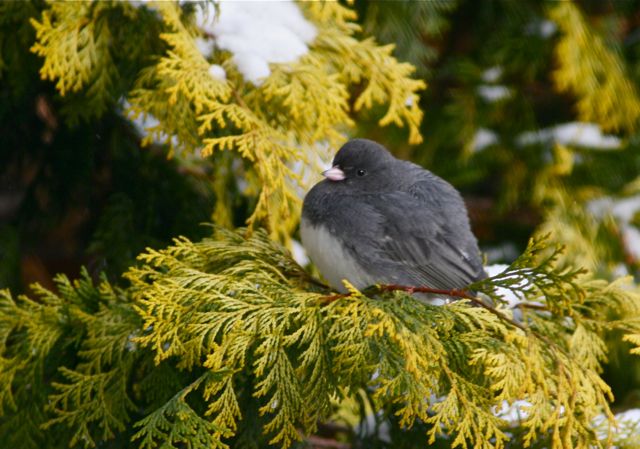
I looked out the window on last Monday morning and there was the first junco of the season, on the lawn near the edge of the woods. The arrival of these "snowbirds" as the locals call them coincides with the first real cold fronts of the season. The junco's gray-skies-above, snow-on-the-ground two-tone plumage mimics the winter weather enjoyed or endured by those of us living in the upper two-thirds of North America.

So I guess that settles it. It's officially winter round here. 


As an aside, my Grandmother Thompson swore that my first word was "junco." I was sitting in a high chair, eating Cream of Wheat, when she pointed at the bird feeder out the kitchen window at a junco. She probably said the word first and I repeated it. I'm not going to claim to have any bird identification prowess at all at the age of 18 months.

Friday, October 14, 2016

A Tribute to Bruce DeMoll

Friday, October 14, 2016
8 comments
Bruce Stockwell DeMoll

I got word from a fellow musician earlier this week that my Uncle Bruce DeMoll had passed away on October 12. He was 86 years old.

Bruce wasn't really my uncle, just my dad's oldest and best friend. He and my dad formed a music trio with their friend Tom Vadakin in their mid-teen years and continued to play together whenever possible until my dad's sudden death in January of 2011. In fact, my dad and I were scheduled to play a gig, subbing in for Bruce, later in the week that my dad died. It was the last thing Dad and I spoke about—he was eager to get better so we could play.

Growing up in a house full of music had a profound effect on my life. My dad playing piano and my mom singing were a more regular soundtrack for us than the TV or stereo. This immersion in melodic sound and the joy that music brought to our family was always heightened when Uncle Bruce was around. In my very early days Brucie would only visit once a year or so, but these occasions always resulted in all-night jam sessions at our house in Pella, Iowa, and later in Marietta, Ohio. I never saw my dad so excited and full of life as when he and Bruce were playing. My dad was a consummate jazz piano player, but he revered Bruce DeMoll as the musical ideal.
A New Year's Eve jam session at 306 Warren St.

Bruce played many instruments well: paint, guitar, flute, clarinet—but it was his saxophone playing that took him around the world, playing with big bands, including the Glenn Miller Orchestra. In the mid-70s when his touring time was over and the club scene in Miami was shifting away from jazz, my dad and Tom Vadakin persuaded Bruce to move back to their hometown of Marietta. It was then that Bruce's life really took shape and his profound influence on generations of area musicians began.

Bruce (with the guitar) was in the band my parents (lower left) formed after they were married in 1956.
Bruce and Dad formed the Duck Creek Ensemble, a sort of jazz dance band that played a few showcase gigs a year with resounding success. With his own combos or solo, Bruce performed thousands of times for weddings, reunions, parties, you name it. He was the first-call player for any show that needed jazz. Any band that was playing a show was thrilled to invite Bruce up on stage to
sit in. He was The Man.

Bruce sitting in with my band The Swinging Orangutangs in 2006.


Yet Bruce's humble demeanor and gentle personality belied his talent. He could play rings around anyone, yet I never heard him brag or gloat. He was a sweet and talented man and I will always think of him as my uncle because he was family.

Once, when I was about 6, I recall being sent to bed during one of my parents' music parties, I had just completed my "star" turn playing brushes for one tune on a metal TV tray in the music room while my dad played some swing blues on the piano. I think Dad was proud to show off my sense of rhythm. I was nervous until we started, then elated as we played. Playing music for people is an addicting feeling. On my way up to bed, I stopped on the stairs, just out of the pool of light coming from the music room, and I watched the lower halves of the adults swaying and dancing. I listened to them laughing and heard them singing to the music being played. I realized in that moment that I, too wanted to be a musician.

My dad didn't make it easy on me. After a few flawed attempts on the trumpet, he sent me away, telling me to come back when I could play. Eventually I settled on the bass guitar and that's when I not only got to play regularly with Dad, but also with Uncle Bruce. About that time, Bruce was coming over to our house several nights a week for dinner. He was a bachelor then and only lived two blocks away. We'd hear the chug of his VW wagon coming up Warren Street and we'd instantly set out another plate for dinner. After dinner he and Dad would ease into the music room and the music would begin to flow. Jazz standards. The music of my life.

There were legendary New Year's Eve sessions at our house—despite the fact that many of the players only got there after finishing a gig at some hotel or party. More than once the music went on until dawn.
Dad and me playing on New Year's Eve.

Bruce's playing always thrilled my dad.

I have recordings on reel-to-reel tape, on cassettes, and on my phone of my dad and Bruce and me playing, and often, my mom singing. Since my dad's death, it's been hard for me to listen to those recordings, because I lost so much music with his passing. I've tried to keep the music alive in my own way, but I'm not nearly the jazz player my dad or Bruce were.

About 10 years ago, Bruce called me to ask if I'd play bass in a trio he had that played a regular Sunday jazz brunch at the Blennerhassett Hotel in Parkersburg, WV. I jumped at the chance. And for the next six years I was there as often as possible, sitting just to his left, watching his left hand. When I joined the trio, the drummer was Chet Backus, another profoundly influential musician who settled in the Mid-Ohio Valley after touring professionally with a variety of bands, including Glen Campbell. To be playing with two giants was a thrill. To listen to and learn from and be surrounded by the music they played was a profound honor. I was in the presence of masters.

When Dad died in early 2011, I took a break from playing in Bruce's trio. The songs and the memories they conjured made me unbearably sad. By the time I was again ready to play, the band personnel had changed—as they are know to do—and, aside from a few substitute gigs, my days of playing with Uncle Bruce were done. The last gig we played was for a charity auction event in Parkersburg, about a year and a half ago. Bruce was his old self, quietly goofy, somewhat spacey, playing piano chord voicings that often buried the melody inside a beautiful bouquet of notes. I didn't know it would be the last time we played. He continued playing gigs until just before his death.
Uncle Bruce at our last gig together, February 7, 2015.

When I heard the news I was sad. "It's the end of an era," I wrote back to my friend Bill, who had told me of Bruce's passing. Then I smiled, thinking how happy my dad would be, because Brucie was coming over to play.

That evening I went out to my dad's grave, in the old orchard on my farm, and I talked to my dad about how much he and Uncle Bruce had meant to me. How much I loved them for the men they were and the music that they gave to me and to the world. And I told him how much I still missed him, my musical North Star. I played Dad some recordings of me and Bruce and Chet Backus playing at the Blenner. And then I put in a request to Dad for our favorite song—one we often started off our gigs or sessions with:—and asked him to play it with Bruce on tenor (not soprano) sax: There Will Never Be Another You.

Here's a song file of my dad and me playing that song.

I love you Uncle Bruce. Let's play the first ending again and then through the verse and chorus one more time.


Here are a few of my favorite recordings from gigs with Bruce.

Song for My Father
Bruce DeMoll, piano
Chet Backus, drums
Bill Thompson, III, bass

The Nearness of You
Bruce DeMoll, piano
Bill Keller, drums
Bill Thompson, III, bass

Round Midnight
Bruce DeMoll, piano
Bill Keller, drums
Bill Thompson, III, bass


Friday, August 12, 2016

American Birding Expo 2016!

Friday, August 12, 2016
2 comments
We're calling it "The World of Birding in One Place!" 


It's the American BirdingExpo and once again Columbus, Ohio, will be buzzing with birders and birding businesses for three busy fall days, September 16 to 18, 2016. Last year more than 2,500 people and 85 exhibitors, hailing from 35 U.S. states and 31 countries joined us for the first-ever Expo at the Grange Insurance AudubonCenter and Scioto Audubon Metro Park. It was monumental fun, and now we're gearing up to do it all again!

Here's this year's limited-edition Expo poster! Designed and hand printed by Bobby Rosenstock/Just A Jar.

In year two of the Expo, there will be more than 100 exhibitors from all over the world selling and promoting everything a birder could want: birding tours, optics, cameras, gear, clothing, bird feeders and houses, artwork, gift items, books, plus destinations, festivals, birding and conservation organizations, and more.
Stephen Ingraham from Carl Zeiss Sports Optics converses with two Expo attendees.

There will be a full array of optics available at the Expo. 
Have I piqued your curiosity, yet? If so, you might have some questions...

How is the Expo Different from a Regular Birding Festival?
As the Expo name suggests, this is an exposition of birding products, destinations, and services. While many of the continent's best birding festivals have a vendor area as a part of the festival, the Expo is nothing BUT a vendor area, with exhibitors on full display mode for most of three days. It's like a grouse or prairie chicken lek where the exhibitors are the displaying male prairie chickens and the consumers are the gathered females, just waiting to be impressed. 

Of course, there are a few similarities between a birding festival and the Expo. We will offer informal morning bird walks before the Expo opens each morning, and many of our exhibitors will be giving short presentations during the Expo. However the central purpose of this event is to connect the worldwide birding marketplace to North American bird watchers. So that's just what we'll do from noon to 6 p.m. on Friday, from 9 a.m. to 5 p.m. on Saturday, and from 11 a.m. to 4 p.m. on Sunday.

By the way, the Expo is hosted by Bird Watcher's Digest and co-hosted by our friends from the American Birding Association, Grange Insurance Audubon Center, and Franklin Country MetroParks.

Do Some Good: Expo Conservation Fund
Not only is this a nature lover's very best chance to sample everything the birding marketplace has to offer, it's also a chance to contribute to bird conservation and nature education through the Expo Conservation Fund. We're once again supporting three vitally important causes: one local, one national, and one international with the funds we raise during the Expo. 

Here are the causes that the Expo Conservation Fund supports:
Local Cause: The Young Urban Naturalists Program at Grange Insurance Audubon Center—sharing the wonders of nature with young people from Columbus City Schools. 
Partner: Grange Insurance Audubon Center.


The Young Urban Naturalists Program


National Cause: Red Knot Rescue and Conservation—funding field study and habitat acquisition efforts along the Delaware Bayshore.
Partner: The American Birding Association

The rufa race of the red knot is critically endangered.


International Cause: Save the Hooded Grebe of Argentina—funding the urgent and vital efforts of BirdLife International and Aves Argentinas to rescue this species from the brink of extinction.
Partner: BirdLife International. The American Birding Expo is proud to be a BirdLife Species Champion for the Hooded Grebe.
Adult hooded grebe with chicks on its back.


How Will the Expo Raise the Money? 
I'm glad you asked!

Although entry to the Expo is free, we're asking for a voluntary $5 per person contribution at the door, which will go directly to the Expo Conservation Fund. We'll also be selling tickets 
to the Expo Conservation Raffle with prizes that include discounted overseas trips, more than a dozen binoculars and scopes, giant gift baskets for birders, original art, and a mind-boggling array of other items. 

Deeper Meaning
All of this stuff is really great, but the Expo means so much more to me than just numbers and products. It's like a family reunion with all of my favorite people from all over the world. I've been so fortunate to get to travel the globe, seeing the birds and meeting the birders of some pretty far-off and fantastic places. So it's wonderful beyond description to be the host of an event that gathers the birding tribe from far and near to meet and connect with one another, and to come together to do some good for birds and the future of birding.

Here's a video we recently completed that gives more insight into the Expo.


So, what do you say? Want to experience The World of Birding in One Place? There's only one spot in this hemisphere where you can do that: The American Birding Expo in Columbus, Ohio, September 16–18, 2016.

If you're planning to come to the Expo, consider registering in advance because it has some advantages. Pre-registrants get a subscription to the Expo e-newsletter  plus notifications about specials, invitations to exclusive Expo events, and expedited entry when they arrive. There's no cost to preregister.

I'll see you out there with the birders!
—BOTB


[BACK TO TOP]