Showing posts sorted by relevance for query lesser prairie chicken. Sort by date Show all posts

Monday, August 29, 2011

Vinyl Siding for Prairie Chickens

Monday, August 29, 2011
17 comments
Did the title of this post make you wonder for a moment? I hope so. Sounds pretty weird, doesn't it? But it's true. Let me explain.

Out on the wide-open expanses of the Oklahoma prairie (and in a few nearby states) the lesser prairie chicken is holding onto its existence, barely. But the species' population is a fraction of what it once was. Prairie chickens were once so abundant that they fed pioneer families for entire seasons. Market hunters shot them until the hunters' arms were too sore to shoot anymore. And over the last two centuries, the species has decline significantly from hunting pressure, but more recently as a result of habitat loss and habitat alteration.

Native short-grass prairie is the specific habitat that the lesser prairie chicken prefers. Plow it up for wheat or soybeans or any other crop and the chickens have to go elsewhere. When trees naturally seed and grow up tall enough to cast a shadow, the chickens, feeling the trees might be ideal for a perching or hiding predator, go elsewhere. Plop down an oil derrick or a line of wind turbines—same result: move along LPCs.

All of these factors have contributed to the decline of this very special prairie species. But lurking just above ground level was another culprit in the lesser prairie chicken's decimation: barbed wire. Researchers in the field had discovered what farm hands and ranchers had known for a long time: prairie chickens often fly just above ground level, and because they often fly in to lekking grounds well before daylight, this flying style made them especially prone to colliding with barbed wire fence. The fence is essentially invisible in low light: rusty wire against sere-brown grass.

That's where the vinyl siding comes in. Field researchers looking for a way to reduce fence-chicken collisions landed on a seemingly ingenious solution. Small, three-to-four-inch sections of vinyl siding, with its interlocking channels, snapped perfectly into place on strands of barbed wire. The white hunks of hard vinyl fluttered slightly in the prairie wind, but held fast to the wire. Unlike pieces of white flagging, the vinyl siding lasted through the intense hot and cold and high winds of the Oklahoma seasons. Best, though, they made the wire fence strands visible to flying lesser prairie chickens, even in low light conditions.

My reason for being in Oklahoma was to deliver a keynote talk to the Lesser Prairie Chicken Festival in Woodward, Oklahoma. This festival offers the expected field trips to temporary viewing blinds set up adjacent to known display leks so attendees can see the chickens in action. Since the LPC was a life bird for me, I was excited to make the trip to Woodward. But the festival also offers something that I found to be even more meaningful—a chance to do something to actually help the lesser prairie chicken: by placing strips of vinyl siding on barbed wire fences in habitat adjacent to known lesser prairie chicken habitat.

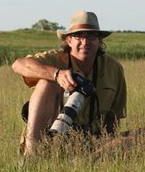
One of the prairie chicken experts I got to meet in Oklahoma was Dr. Dwayne Elmore (above). He knew the location of most of the active LPC leks in the area.


We met a guy from the Oklahoma Department of Natural Resources who selected a section of fence for us to mark. He demonstrated how to mark the fence for the chickens, pointed to several large burlap sacks of cut-up vinyl siding, then pointed to a long stretch of as yet unmarked barbed-wire (locals call it "bobwire") fence.


We set to work.
The idea was to stagger the siding pieces every two feet or so on the top two strands of wire. This seems to be the most effective use of this collision deterrent, since it's right at the height at which LPCs do much of their flying at dawn and dusk.

Here's a piece of vinyl siding snapped into place. The channels in the siding are just the right size to snap down over a strand of wire, between the barbs/bobs.


As you can see, the white siding pieces present a visual image that's easy to notice.

After the fence was marked and we ran out of siding pieces, we felt a real sense of accomplishment. Here's hoping the fence-marking program results in greatly lower mortality from fence strikes, which could in turn mean more chickens dancing on the prairie.

I've got at least a couple more posts in mind about this wonderful part of the world and the great birds and people there. I'll try to get back for a BOTB visit to the big wide open of Oklahoma sometime soon.

Tuesday, May 3, 2011

Wind Power and Birds

Tuesday, May 3, 2011
9 comments

Recently I was birding in Oklahoma and I was astounded at the number of wind farms—clusters of giant wind turbines—that I saw as I drove around the northwestern part of the Sooner State. This should not have surprised me. After all, Oooooooooklahoma is the state where "the wind comes sweepin' down the plain!" And as the photo above shows, wind-generated power has been around a long time.

No bird watcher would argue against the notion that our country—and the world at large—needs to begin harnessing other, greener forms of energy. In many ways wind power is as green as it gets. The wind blows, giant turbines are rotated at high speeds, and energy is generated by this motion. However the problems with wind energy center on these same giant turbines. Among the turbine-related issues are:

1. Though they look as though they are spinning languidly, the giant blades—especially the tips of the blades—are actually moving at several hundred miles per hour. Anything trying to move past these blades, but within their reach, is going to be hit by them. For a flying bird or a bat, this means instant death. We know that there is mortality at most wind turbine sites. And we know that some are far worse than others based upon their location relative to patterns of bird movement and migration.

2. And speaking of location, lesser prairie chickens and other grassland species of lekking gallinaceous birds (such as both greater and Gunnison sage-grouse) will leave areas when wind turbines are erected. In some cases this moves birds off lekking grounds where they (and their ancestors) have been doing courtship displays for decades if not a century or more. To a prairie chicken a wind turbine (or a cell tower or a string of high-tension power line towers) looks too much like a predator perch, so they leave the immediate area permanently. The same avoiding predators dispersal behavior would happen if we put a bunch of trees out on the prairie.


Lesser prairie chicken

3. Them things is ugly! Opponents of offshore wind farms shout most loudly about how clusters of turbines disrupt their natural vistas. And I have to say that when I've been out in the great wide open spaces of the Great Plains, scanning with my binoculars for longspurs or pipits and a cluster of wind turbines has come into my view, my reaction is negative, not positive. They are an eyesore we're not yet used to seeing.

At their most virulent, the arguments for and against wind power sound like the daily animosity we hear on the political talk shows. Proponents of wind power—and especially the wind industry—are trying to wear the Green Energy badge with pride while largely ignoring the legitimate concerns about incidental deaths of birds and bats. Not ALL wind turbines are bad. But the ones that are bad can be REALLY bad. Still, we want to reduce the consumption of fossil fuels, right?

On the other hand, anti-wind-power people sometimes seem to want to ban all forms of turbine-generated energy. Both sides cite statistics to back their claims (environmentalist/birders say towers kill millions of birds. The wind-energy industry counters that far more birds are killed by collisions with cars or window glass or by feral cats. Perhaps this is true, but why add another bird-killing element to our continent? In many states there is basically no regulation on the siting of wind farms, which means towers go up and start spinning before we know the impact on birds and wildlife.

So whom are we to believe?

What we really need is a wind turbine design that is efficient in generating energy but that is also safer for birds and bats. Furthermore we need some cooperative action among environmentalists, policy makers, and the wind industry to ensure that the impacts on birds and wildlife are considered when wind farms are being sited. Right now, it's all about location, location, location.

Until that day, all we can hope for is that the information gathering and the conversation continues. Perhaps we can find a happy medium.

We need wind-generated power. But we need it to be done right.

Here are some interesting links to sites covering this controversial topic.

The American Bird Conservancy's Wind Power Policy
http://www.abcbirds.org/abcprograms/policy/collisions/wind_farms.html

Misconceptions About Bird Mortality and Wind Power:
http://www.treehugger.com/files/2006/04/common_misconce.php

How Turbine Design Can Reduce Bird Impacts
http://science.howstuffworks.com/environmental/green-science/wind-turbine-kill-birds.htm

The USFWS Proposes Voluntary Guidelines to Avoid Bird Deaths
http://www.huffingtonpost.com/2011/02/10/wind-energy-voluntary-gui_n_820708.html

KQED-TV Feature on the Altamont Pass, California Wind Farms
http://www.youtube.com/watch?v=RtgBWNKwBkE

Black Swamp Bird Observatory's Wind Energy Issues Page
http://www.bsbobird.org/wind_energy.htm

Blog Post by Ted Eubanks on the Wind Energy Rush
http://www.birdspert.com/?p=1630

The American Wind Energy Association
http://www.awea.org/

Laura Erickson's Blog Post About Testifying in Court Regarding Wind Power
http://lauraerickson.blogspot.com/2011/04/from-court-transcripts.html

Friday, April 15, 2011

Two Words

Friday, April 15, 2011
4 comments
Yes! and....

Yes!

Those rather poor photos represent my two latest life birds: the black-capped vireo and the lesser prairie chicken. I got both of them while attending The Woodward Lesser Prairie Chicken Festival in Woodward, Oklahoma. This small-sized birding fest is a keeper. And the birds are stupid ossum.

I'm going back for better chicken photos tomorrow, if the weather gods comply. Got great looks at both species, though, and that counts most of all for me. Just love being out here in the land of the big sky—it does one's heart some good.

Friday, December 23, 2011

Thinking About My Bird of the Year 2011

Friday, December 23, 2011
6 comments
It's been an incredible year of bird watching. As I think back on some of the sweet birds I've seen—some of them lifers, some just old favorites—I find it nearly impossible to pick just one as my BOY—my Bird of the Year. Here are some of the nominees: Above is the lesser prairie chicken I got to see, with dozens of his fellow lekkers, outside of Woodward, Oklahoma, during the Lesser Prairie Chicken Festival. What a soul-stirring morning spent in a small blind, waiting for enough of the dawn to coalesce so I could see these incredible birds perform their ancient courtship ritual.

An even rarer life bird came to me (really I went questing after it) in central Texas in late June. The male golden-cheeked warbler that I found at Friedrich Wilderness Park north of San Antonio was my next-to-last U.S.-breeding warbler species (only the hard-to-see Colima warbler remains unchecked on my life list).

Actually the first golden-cheeked individual I saw was a begging fledgling, which looked a whole lot like an adult bird only rattier and fluffier of plumage. When the adult male came in, followed by the adult female, and the three of them dropped down to drink and bathe in a small pool 20 feet away, my identification was confirmed. And I began to suppress a scream of joy. It was a extra poignant to see a fledgling of this federally endangered species—and to think of how few fledgling golden-cheeked warblers there were in the world at that moment.

I'm often asked, as most birders are, to share which species is my favorite bird. Since my pre-teen years, my answer has been red-headed woodpecker. I'm not sure why, but this bird just gets me fired up. Perhaps because this is a bird of contradictions. They are increasingly rare here in southeastern Ohio, but they were common in the southeastern Iowa of my childhood. They are ID-able from a great distance in flight flashing the semaphore of white and black wings, yet they often go unnoticed as they perch quietly. Some red-headeds migrate, others don't. Where they are common they are reliable to see, but they can also show up just about anywhere, especially in fall migration. They are often confused with the much more common red-bellied woodpecker and species that has, at best, a red Mohawk stripe of red. And the red on the red-headed's head (say THAT 10 times fast)—well it's perhaps the most compelling red on any bird. Yep, it's my fave. This year we heard about a nesting colony of RHWOs about an hour away from home in West Virginia, so we took several trips there to commune with them.


While traversing the New River Gorge Bridge on the catwalk below the road surface, I got to enjoy my closest-ever look at an adult peregrine falcon. The above photo was taken with my Canon G12 point-and-shoot camera. This bird was CLOSE! The bird of prey highlight of the year for me.

The local birding grapevine whispered in my ear about a possible sandhill crane in our county. I was initially doubtful because we have an exploding population of great blue herons in the region. Sure enough, at dusk the same day I first heard about the crane, we found it. Foraging in a field of newly sprouted sweet corn. It stayed around long enough for me to get several birding friends out to see it. My first-ever Ohio sandhill crane and, if I kept a Washington County, Ohio bird list this would be a nice addition to it!

These are just four of the nominees for my BOY. I'll do my best to share the rest during the holidays, before the list stats anew at 12:01 am on 1/1/12.

Wednesday, April 20, 2011

Lesser Prairie Chicken

Wednesday, April 20, 2011
2 comments
This adult male lesser prairie chicken spent our morning together dancing in his lek on the Selman Ranch, near Buffalo, Oklahoma.

I didn't want you to think I didn't get any good photos! I'll tell the whole story in the days ahead.


[BACK TO TOP]