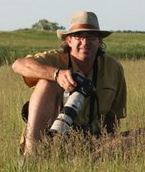
I have stalked and seen the horned guan. Oooh. It feels good just to say it.
Looming over the shore of Guatemala's Lake Atitlan, where the Atitlan grebe once lived, until its extinction in the late 1980s, stands Volcan San Pedro. On San Pedro's steep slopes facing the lake, above the cultivated patches of corn, coffee, and avocados, lies a bit of cloud forest. It was here that a horned guan and I met.
But it was no easy bird to see. In fact, the hike up the volcano to the horned guan's preferred habitat was incredibly strenuous. For those of us not used to the thinner air at 9,000 feet, breathing was difficult. And for those of us who spend most of our waking hours behind a desk, feeling the burn in our calves and thighs as we climbed a long, steep trail was quite an experience. If birding is ever added to the X-Games, climbing to see the horned guan should be the main event.
To be fair to our hosts from Guatemala, they had warned us about the trail and the climb. Horned guans are deep mountain forest birds. To see them you must seek them where they live. It is this preference for remote highland habitat and their rather odd preference for living in the trees rather than on the ground that makes the horned guan one of the most sought-after birds in Central America. Oh, and they taste really good, according to local hunters. Not to worry, the guans in this parque are protected.
We left our quaint and cozy Hotel Tolliman before dawn and embarked on our taxi boat which whisked us across Lake Atitlan to the town of San Pedro. Here a convoy of small buses and trucks carried us to the visitors' center at the Parque Ecologico de Volcan San Pedro at the base of the volcano. This is an extinct volcano, so we had no worries about melting our hiking boots on red-hot lava.
We started the climb up the path about an hour after dawn, but the birding was so good that we made little progress for the first hour. Solitaires, wrens, familiar warblers (mostly Tennessees, Wilson's, and Townsend's) several darting hummingbirds and scores of other species stopped us along the single-track path. The path was so well-used that in many places there was an inch or more of fine dust which floated in the air with each footfall. Time and time again we'd hear the cry "Coming through!" from one of our group, and we'd all step off the path to let a local farmer pass by heading up the mountain with tools, or down the mountain loaded with a harvest of wood, coffee, or corn.
Soon we began to get the feeling that if we did not get moving, we might miss the guan, which was reported to be most seeable between the hours of eight and nine in the morning. Our progress was necessarily slow, but the day was glorious with cool air and brilliant sun shafts poking through the forest canopy. We passed field after field as we ascended the volcano. We gnawed the tasty flesh off of ripe maroon coffee fruits, spitting out the bean inside. We depleted our water supply.
After a short break at the mirador, an overlook about halfway to the top of the volcano, where we ate a bit of breakfast and resupplied ourselves with liquids, we hit the trail again, climbing with a slow determination. We began making jokes about the guan.
"Gwhen are we guanna see a guan?"
"Guan wit your bad self!"
"I guan Youuuuu, to show me the way... Everyday!"
"Guan-tan-amera!"
"One more bad pun and I'll send you to Guan-tanamo!"
We laughed when we had enough breath to do so. Soon we found ourselves above the patches of agriculture and entering mature woodland. Our energy level and mood lifted.
Here are some notes I made later that day about the events of the following half hour:
After hiking all morning and well into the afternoon up the serious grade of Volcan San Pedro, we hear a whistle from 150 yards up the path, and the crackle of the small FRS radio unit in Marco's hand. The horned guan had been sighted, oddly by one of the local policemen assigned to accompany us. The news flashes like lightning through our group, now strung out along several hundred yards of jungle path. We in turn whisper-shout and whistle downslope to those trailing us. Pandemonium ensues.
I burst into a Frankensteinlike run up the path to the guan spot. But I realize almost immediately that this is extremely hard given my weary, leadlike legs, lightly sprained right ankle, and difficulty in breathing in the thin air at this altitude. So it's 10 steps at full speed, each gaining me about 12 inches in altitude and three feet of forward progress, then 20 seconds of gasping and resting my burning legs.
Somehow I get to the spot, my chest heaving with each deep breath, the sweat pouring down my face. My binocs go right to my eyes and I aim them in the direction that our companions Simon and Martin are pointing. There, on a horizontal branch below the canopy, I spy the large black and white bird sitting still about 50 yards into the forest. He is positively prehistoric in appearance. Black as night on the back, with a white chest and belly. My labored breath combined with my pounding pulse and overall exhilaration make it nearly impossible to hold my binocs still. The guan, sitting still, bounces up and down in my view as I fight to control my breathing.
My friend grabs my scope and trains it on the bird. Quiet shouts of joy and gasps follow, but the guan moves before I can get onto the scope myself. The bird reappears slightly to the right, and I get another good binoc look.
I dance a jig and silently shout a prayer of thanks to the birding gods. Quiet high-fives and sweaty hugs, and a few kisses go all 'round the group. Others in our large party are still struggling madly up the rocky, dusty path to see this rarest of all Guatemalan birds. And we agree to let them charge past us up the hill, where the newly minted celebrity policemen are once again searching for the bird.
Those of us in the first wave to see the guan cannot believe our luck. If you can possibly earn a life bird, this might be one that we've earned. We all sink to the ground along the edge of the path and rest, happy to the point of giddiness.
The bird is refound another hundred yards up the path and I know I MUST try to digiscope it. The primary obstacles to this are the fact that all the ground slopes at a 45 degree angle and the path is only wide enough for one person in most places. Plus, the guan is deep in the jungle where a million vines, branches, and leaves block most views.
I lurch up the path to where the bird is showing itself once again. My entire body aches, I ponder what my heart attack will feel like when it comes. This last run nearly kills me. I stop, panting just six steps from a relatively flat portion of the trail from which five other birders are training their optics on the same horned guan.
"Just six more steps, dude! Come ON!" comes the call of encouragement from Alvaro, as he sticks out his arm and helps me climb the rest of the way. I start trying to catch my breath right away, so I don't scare the bird. He is MUCH closer this time, and I quickly set up my scope to try to get a few documentary digiscoping shots.
I am thrilled. The guan sits for 15 minutes and everyone who makes it this high up Volcan San Pedro, is rewarded with a leisurely view of the bird. I snap a dozen photos of varying quality. Then as the group, one after another, heads down the volcano, I sit down to perform a little ritual before I leave this memorable, sacred spot. Alone for the moment, leaning back with my aching torso against a tree, I write a few words on a small piece of paper, light it on fire, and watch it burn itself out on the dusty path.
Below me the waters of Lake Atitlan shimmer in the late afternoon sun. My heart rises to soar beyond the distant horizon, like the smoke from my tiny fire and the fires of the Guatemalan farmers cooking their tortillas by their small mountainside fields. I close my eyes and drift into a dream.
=-=-=-=-=-=-=-=-=-=-=-=-=-=-=-=-=-=-
At my first glance through my binoculars, the guan seemed to be staring directly at me, its black-and-white eye giving it a surprised, yet blank look. I shuddered, whether from the excitement of finding this rare bird, or from being a bit surprised at its odd appearance. This is a remarkable weird-looking bird. And I feel utterly blessed to have seen it.
Following are some of the day's memorable images.
 Our party was escorted up the volcano by two policemen from the village of San Pedro. They were the ones who spotted the horned guan first. Neither one had binoculars.... Later, they received a heartfelt gratuity from us for their help and good eyes.
 Up, up, up we climbed, stopping every 10 or 20 steps to rest and catch our breath. I found myself wondering how many years these old cut paths had been used by the local villagers.
 Despite the strenuous hike, Julie enjoyed the vistas of Lake Atitlan far below us.
 Several dozen local farmers passed us heading up or down. This fellow is carrying wood for cooking, heading down the volcano to the village. It's a bundle suspended from a strap across his forehead.
 The exact spot where I photographed the guan. He is the tiny dark spot at the center of this image. Please scroll down for a better image of this odd bird.
 Hugo, BT3, and Marco celebrate the guan sighting. Afterwards, we asked Marco, one of Guatemala's best bird watchers, what he thought our chances were to see the guan, when we started out. "About 5 percent" he said. We were SO lucky.
 Julie, Martin Reid, and Simon Thompson celebrate our initial sighting of the guan.
 Tired to the point of falling over, but happy to have made the effort to seek the horned guan on Volcan San Pedro. Now came the long trek down the volcano, which we renamed The San Pedro Thighmaster.
 Heading down the volcano after everyone got great looks at the horned guan. The walk down seemed much shorter....
 Back at the entrance to the Parque Ecologico, we collapsed into a post-guan siesta.
 My best digiscoped image of the horned guan, a dream-come-true bird.